
The battle against the cocciniglia
Nederlands hieronder – Italiano sotto
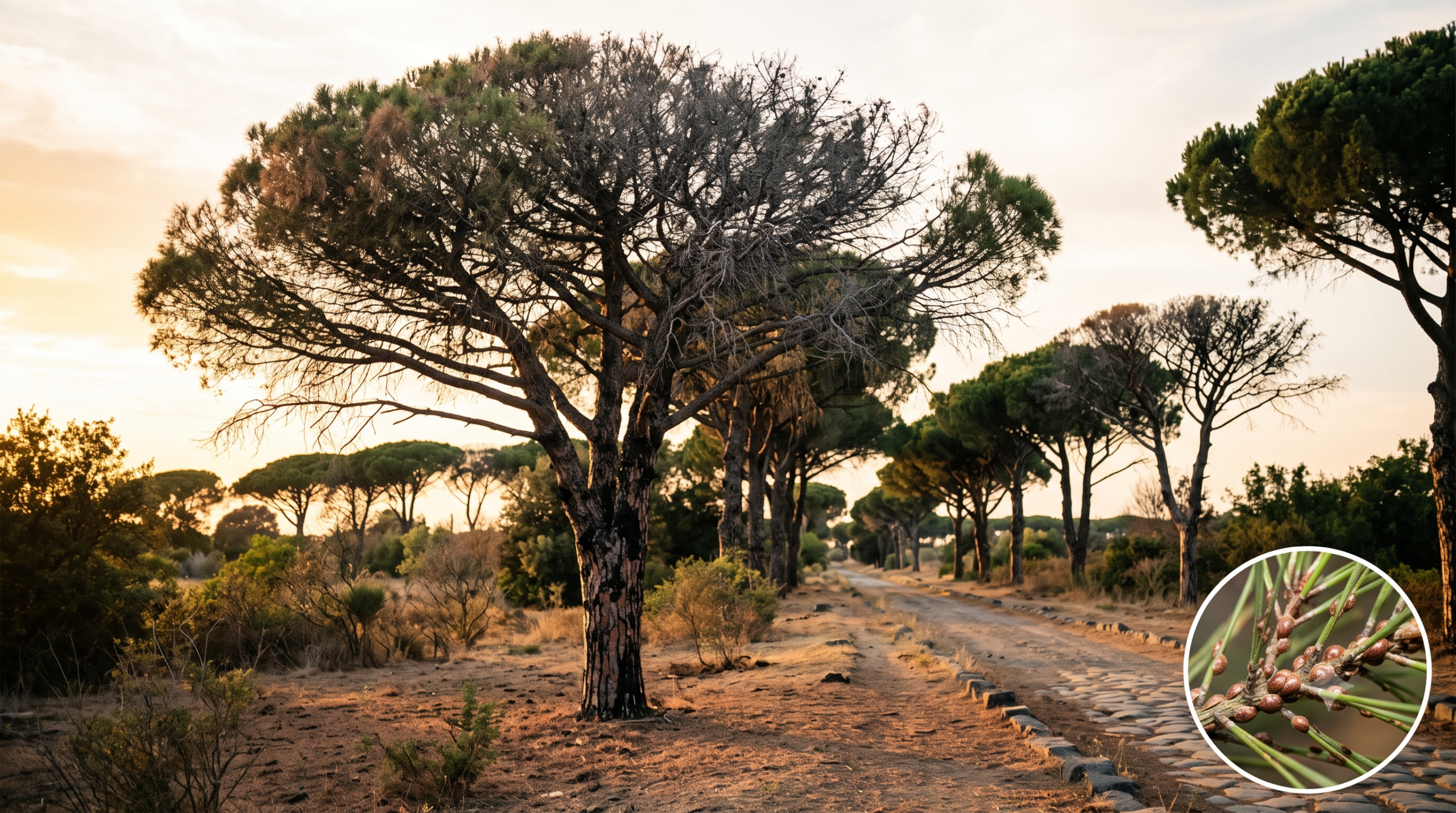
Driving from Rome towards Ostia, you see it on both sides of the Cristoforo Colombo: grey crowns, bare branches, trees that have not looked well for some time but are still standing. The stone pines that have shaped Rome’s skyline for centuries are sick. Not everywhere, but in enough places to notice.
The cause is an insect the size of a pinhead, the cocciniglia tartaruga, scientifically Toumeyella parvicornis. In severe cases it kills the tree. The insect has no natural predator in Europe, which explains why no one has been able to stop it.
This is the story of that insect, and of what is disappearing from the landscape around Rome as a result.
What is the cocciniglia?
The culprit is officially known as Toumeyella parvicornis, known in Italy as the cocciniglia tartaruga del pino — the pine tortoise scale.
The insect attaches itself to the needles and young shoots of pine trees and taps into the sap. The creature itself is barely larger than a pinhead and would go entirely unnoticed were it not for the consequences of its presence. Those are visible enough: the scale secretes a sticky, sugar-rich substance called honeydew, which coats needles and bark. On that honeydew a black fungus quickly takes hold — sooty mould — leaving the crown of an infested tree looking grey and withered within months. Needles yellow, drop prematurely, and the tree loses its capacity for photosynthesis. In severe cases it dies.
The species originates in North America and appeared in Europe for the first time in 2014, near Naples. In 2018 it was found in Rome, on the pino domestico — the characteristic stone pine whose silhouette has defined the city for centuries, from the Via Appia to the gardens of Villa Borghese. Since then the insect has spread rapidly. Official guidelines from the Lazio region describe the infestation moving along the Cristoforo Colombo corridor towards the coast and into the Pineta di Castel Fusano.
This vast pine forest is a defining feature of Rome’s coastal landscape. The damage there has been severe. According to RaiNews, around 12,000 trees have been lost in the Ostia area. Legambiente put the figure at nearly a third of the pine stock in the affected zone. Corriere della Sera described the situation in 2024 as a serious attack on the roughly 900-hectare Pineta di Castel Fusano. Coming on top of earlier fire damage, the scale insect has become a new and major threat. Dead trees and branches cause not only ecological harm — they also raise the risk of falling timber and increase fire danger, which is why removal follows.
Estimates from local authorities and campaign groups including Italia Nostra suggest that around eighty percent of Rome’s pine trees are now affected. The absence of any natural predator in Europe goes a long way towards explaining why the infestation has spread so freely. In July 2026, CREA reported that Toumeyella parvicornis has now reached several Italian regions, including Lazio, Campania, Abruzzo, Puglia, Tuscany and Marche.
Why treatment is not a solution
The only method that works to any degree is endotherapy: an insecticide, usually abamectin, is injected directly into the trunk through small boreholes and carried upward through the sap. Researchers and authorities in Rome report that around ten percent of the insects survive treatment, meaning the procedure must be repeated annually to remain effective. There is no structural solution in sight — it is symptom management, repeated every year at considerable cost, with no end point.
Work is underway on alternatives. In the United States, where the species originates and natural enemies exist, a parasitoid wasp has been identified that can suppress the scale. Researchers at CREA, Italy’s agricultural research institute, are testing this biological control agent under quarantine conditions ahead of a possible introduction in Italy. That is promising, but such processes take years: before any large-scale release can be considered, it must be established that the wasp poses no risk to other insects or plants.
At Castel Fusano, attention is also turning to greater diversity of tree species. The future of the area does not necessarily mean planting the same pines again in the same numbers. A more varied woodland would be more resilient. The Castel Fusano Prima campaign focuses on protecting monumental pines while also planting holm oaks, common oaks and cork oaks.
Finally
The pine tortoise scale is no longer a Roman problem. The insect has reached six regions, has done extensive damage to the coastal zones of Lazio, and is advancing into Tuscany and Puglia. Each new province means starting again: monitoring, treating, felling, replanting.
What Rome is learning is that endotherapy buys time but does not provide an ending. The real hope lies with the parasitoid wasp — but that is not coming soon. Biological control requires years of research before a single specimen can be released.
Meanwhile the landscape is changing. The stone pines that have shaped Rome’s skyline for centuries are disappearing at speed. What replaces them will be more varied, younger and more fragile. Whether it will also be more beautiful depends on how much patience there is. Perhaps it is inevitable that the Roman landscape will look different in a few decades. The question is not only how many pine trees can still be saved, but what kind of landscape takes their place.
De strijd tegen de cocciniglia
Wie door Rome rijdt richting Ostia, ziet het aan weerszijden van de Cristoforo Colombo: grijze kronen, kale takken, bomen die er al een tijdje niet meer bij staan maar nog wel rechtop staan. De parasolden die het silhouet van Rome al eeuwenlang bepalen, zijn ziek. Niet overal, maar wel op genoeg plekken om op te vallen.
De oorzaak is een insect ter grootte van een speldenkop, de cocciniglia tartaruga, wetenschappelijk Toumeyella parvicornis. Bij een zware aantasting sterft de boom. Een natuurlijke vijand heeft het insect in Europa niet, en dat verklaart waarom niemand het heeft kunnen tegenhouden.
Dit is het verhaal van dat insect, en van wat er in het landschap rond Rome door verdwijnt.
Wat is de cocciniglia?
De boosdoener heet officieel Toumeyella parvicornis, in Italië bekend als de cocciniglia tartaruga del pino — de schildluis van de pijnboom.
Het insect zet zich vast op de naalden en jonge twijgen van pijnbomen en boort de sapstromen aan. Het beestje zelf is nauwelijks groter dan een speldenkop en zou zonder de gevolgen van zijn aanwezigheid volkomen onopgemerkt blijven. Die gevolgen zijn wel degelijk zichtbaar: de luis scheidt een kleverige, suikerrijke stof af, honingdauw genoemd, die op naalden en schors neerslaat. Op die honingdauw groeit al snel een zwarte schimmel — roetdauw — waardoor de kroon van een aangetaste boom er binnen een paar maanden grijszwart en verlept bij kan hangen. De naalden vergelen, vallen vroegtijdig af, en de boom raakt zijn vermogen tot fotosynthese kwijt. Bij een zware infestatie sterft de boom.
De soort komt oorspronkelijk uit Noord-Amerika en dook voor het eerst in Europa op in 2014, in de omgeving van Napels. In 2018 werd ze ook in Rome aangetroffen, op de pino domestico — de karakteristieke parasolden die het silhouet van de stad al eeuwenlang bepalen, van de Via Appia tot de tuinen van de Villa Borghese. Sindsdien heeft het insect zich in hoog tempo verspreid. De officiële richtlijnen van Lazio beschrijven dat het verspreidingsgebied onder meer richting de Cristoforo Colombo loopt en uiteindelijk de kust en de Pineta di Castel Fusano bereikt.
Deze enorme pijnboomzone vormt een belangrijk onderdeel van het landschap van de kust van Rome. De cocciniglia heeft daar grote schade veroorzaakt. Volgens berichtgeving van RaiNews zijn in het gebied rond Ostia ongeveer 12.000 bomen verloren gegaan. Legambiente sprak daarbij over bijna een derde van het pijnbomenbestand in de betreffende omgeving. Corriere della Sera beschreef de situatie in 2024 als een ernstige aantasting van de ongeveer 900 hectare grote Pineta di Castel Fusano. Naast de eerdere schade door branden werd de cocciniglia een nieuwe grote bedreiging voor de pijnbomen. Dode bomen en takken veroorzaken niet alleen ecologische schade. Ze vergroten ook het risico op vallende takken en bomen en kunnen bij brand een extra gevaar vormen en worden daarom verwijderd.
Schattingen van lokale instanties en actiegroepen als Italia Nostra spreken inmiddels van zo’n tachtig procent van de Romeinse pijnbomen die is aangetast. Een natuurlijke vijand ontbreekt vooralsnog in Europa, en dat verklaart voor een groot deel waarom de plaag zich zo ongeremd heeft kunnen uitbreiden. In juli 2026 meldde CREA dat Toumeyella parvicornis inmiddels verschillende Italiaanse regio’s heeft bereikt, waaronder Lazio, Campanië, Abruzzo, Puglia, Toscane en Marche.
Waarom de behandeling geen oplossing is
De enige methode die tot nu toe enigszins werkt, is endotherapie: een insecticide, meestal abamectine, wordt via kleine boringen in de stam van de boom geïnjecteerd en verspreidt zich vervolgens via het sapvocht naar de kroon. Onderzoekers en betrokken instanties in Rome melden dat zo’n tien procent van de insecten een behandeling overleeft, wat betekent dat de ingreep jaarlijks herhaald moet worden om effect te blijven houden. Van een structurele oplossing is dus geen sprake — het is symptoombestrijding die telkens opnieuw geld en tijd kost, zonder uitzicht op een moment waarop het probleem definitief is opgelost.
Er wordt wel gewerkt aan alternatieven. In de Verenigde Staten, waar de soort van oorsprong voorkomt en dus ook natuurlijke vijanden heeft, is een sluipwesp geïdentificeerd die de schildluis kan onderdrukken. Onderzoekers van onder meer CREA, het Italiaanse landbouwonderzoeksinstituut, zijn bezig deze biologische bestrijder onder quarantainecondities te testen voor introductie in Italië. Dat is veelbelovend, maar dit soort trajecten duurt jaren: eerst moet worden vastgesteld dat de sluipwesp zelf geen nieuwe problemen veroorzaakt voor andere insecten of planten, voordat er ook maar aan een grootschalige vrijlating gedacht kan worden.
In Castel Fusano wordt inmiddels ook gekeken naar een grotere variatie aan boomsoorten. De toekomst van het gebied hoeft niet noodzakelijk te bestaan uit opnieuw duizenden dezelfde pijnbomen. Biodiversiteit kan het landschap weerbaarder maken. Ook de campagne van Castel Fusano Prima richt zich op het beschermen van monumentale pijnbomen én het planten van onder meer steeneiken, eiken en kurkeiken.
Tot slot
De cocciniglia tartaruga is inmiddels geen Romeins probleem meer. Het insect zit in zes regio’s, heeft de kustzones van Lazio grotendeels aangetast en rukt op richting Toscane en Puglia. Elke nieuwe provincie is opnieuw beginnen: monitoren, behandelen, kappen, herplanten.
Wat Rome leert, is dat endotherapie tijd koopt maar geen einde maakt. De echte hoop ligt bij de sluipwesp — maar die komt er niet snel. Biologische bestrijding vereist jaren onderzoek voordat er ook maar één exemplaar vrijgelaten wordt.
Ondertussen verandert het landschap. De parasolden die het silhouet van Rome al eeuwenlang bepalen, verdwijnen in hoog tempo. Wat ervoor terugkomt, wordt gevarieerder, jonger en kwetsbaarder. Of het ook mooier wordt, hangt af van hoeveel geduld er is. Misschien is het daarom onvermijdelijk dat het Romeinse landschap er over enkele decennia anders uitziet. De vraag is niet alleen hoeveel pijnbomen nog kunnen worden gered, maar ook welk landschap ervoor in de plaats komt.
La lotta contro la cocciniglia
Percorrendo la Cristoforo Colombo in direzione Ostia, si nota subito: chiome grigie, rami spogli, alberi che non sembrano in salute da tempo ma reggono ancora in piedi. I pini domestici che caratterizzano il paesaggio di Roma da secoli sono malati. Non ovunque, ma in abbastanza punti da non passare inosservato.
La causa è un insetto grande quanto una capocchia di spillo, la cocciniglia tartaruga, scientificamente Toumeyella parvicornis. Nei casi più gravi uccide l’albero. L’insetto non ha nemici naturali in Europa, il che spiega perché nessuno sia riuscito a fermarlo.
Questa è la storia di quell’insetto, e di ciò che sta scomparendo dal paesaggio intorno a Roma.
Cos’è la cocciniglia?
Il responsabile si chiama ufficialmente Toumeyella parvicornis, noto in Italia come cocciniglia tartaruga del pino.
L’insetto si fissa sugli aghi e sui giovani rametti dei pini, succhiandone la linfa. L’esemplare in sé è a malapena grande quanto una capocchia di spillo e passerebbe del tutto inosservato se non fosse per le conseguenze della sua presenza. Queste sono invece ben visibili: la cocciniglia secerne una sostanza appiccicosa e zuccherina chiamata melata, che si deposita su aghi e corteccia. Su questa melata si sviluppa rapidamente un fungo nero — la fumaggine — che nel giro di pochi mesi lascia la chioma di un albero colpito grigia e avvizzita. Gli aghi ingialliscono, cadono prematuramente e l’albero perde la capacità di fotosintesi. Nei casi più gravi muore.
La specie è originaria del Nord America ed è comparsa in Europa per la prima volta nel 2014, nei pressi di Napoli. Nel 2018 è stata rilevata anche a Roma, sul pino domestico — il caratteristico pino a ombrello che da secoli definisce la silhouette della città, dalla Via Appia ai giardini di Villa Borghese. Da allora l’insetto si è diffuso rapidamente. Le linee guida ufficiali della Regione Lazio descrivono come l’infestazione si stia espandendo lungo la Cristoforo Colombo verso la costa e la Pineta di Castel Fusano.
Questa vasta pineta è un elemento fondamentale del paesaggio costiero romano. I danni sono stati ingenti. Secondo RaiNews, nella zona di Ostia sono andati perduti circa 12.000 alberi. Legambiente ha parlato di quasi un terzo del patrimonio di pini nell’area colpita. Il Corriere della Sera ha descritto nel 2024 una grave compromissione della Pineta di Castel Fusano, che si estende per circa 900 ettari. Già provata dagli incendi degli anni precedenti, la pineta ha trovato nella cocciniglia una nuova e seria minaccia. Alberi e rami morti non causano solo danni ecologici: aumentano anche il rischio di cadute e costituiscono un pericolo aggiuntivo in caso di incendio, motivo per cui vengono abbattuti.
Le stime di enti locali e associazioni ambientaliste come Italia Nostra indicano che circa l’ottanta percento dei pini romani è ormai colpito. L’assenza di nemici naturali in Europa spiega in larga misura perché la diffusione sia avvenuta in modo così incontrollato. Nel luglio 2026, il CREA ha comunicato che Toumeyella parvicornis ha raggiunto diverse regioni italiane, tra cui Lazio, Campania, Abruzzo, Puglia, Toscana e Marche.
Perché il trattamento non è una soluzione
L’unico metodo finora parzialmente efficace è l’endoterapia: un insetticida, solitamente abamectina, viene iniettato direttamente nel fusto attraverso piccoli fori e si distribuisce tramite la linfa verso la chioma. I ricercatori e le autorità di Roma segnalano che circa il dieci percento degli insetti sopravvive al trattamento, il che significa che l’intervento deve essere ripetuto ogni anno per mantenere l’effetto. Non esiste quindi una soluzione strutturale: si tratta di una gestione dei sintomi, da ripetere ogni anno con costi considerevoli, senza che si intraveda una risoluzione definitiva.
Si lavora tuttavia ad alternative. Negli Stati Uniti, dove la specie è originaria e dove esistono nemici naturali, è stato individuato un parassitoide — una piccola vespa — in grado di contenere la cocciniglia. I ricercatori del CREA stanno testando questo agente di controllo biologico in condizioni di quarantena in vista di una possibile introduzione in Italia. È una prospettiva incoraggiante, ma questo tipo di percorso richiede anni: prima di qualsiasi rilascio su larga scala occorre verificare che la vespa non rappresenti un rischio per altri insetti o piante.
A Castel Fusano si sta già guardando a una maggiore varietà di specie arboree. Il futuro dell’area non deve necessariamente prevedere la messa a dimora degli stessi pini nelle stesse quantità. Un bosco più diversificato sarebbe più resistente. La campagna Castel Fusano Prima punta alla salvaguardia dei pini monumentali e alla piantumazione di lecci, querce e sughere.
Per concludere
La cocciniglia tartaruga non è più un problema romano. L’insetto è presente in sei regioni, ha devastato le zone costiere del Lazio e avanza verso Toscana e Puglia. Ogni nuova provincia significa ricominciare da capo: monitorare, trattare, abbattere, ripiantare.
Quello che Roma sta imparando è che l’endoterapia guadagna tempo ma non offre una via d’uscita. La vera speranza è nella vespa parassitoide — ma non arriverà presto. Il controllo biologico richiede anni di ricerca prima che un singolo esemplare possa essere rilasciato.
Nel frattempo il paesaggio cambia. I pini domestici che da secoli caratterizzano la silhouette di Roma stanno scomparendo rapidamente. Quello che li sostituirà sarà più vario, più giovane e più fragile. Se sarà anche più bello dipende da quanta pazienza ci sarà. Forse è inevitabile che il paesaggio romano appaia diverso tra qualche decennio. La domanda non è solo quanti pini possano ancora essere salvati, ma che tipo di paesaggio prenderà il loro posto.
Links
https://it.wikipedia.org/wiki/Toumeyella_parvicornis
https://www.regione.lazio.it/cittadini/agricoltura/avversita-piante/toumeyella-parvicornis